

Cultural Foundation, a cultural centre under the Department of Culture and Tourism – Abu Dhabi (DCT Abu Dhabi),unveils the second phase of Skin of Dreams. Following the launch of the exhibition’s first phase on 9 April 2026, this phase presents a complete look atDawood’s momentous artworks.
The opening phase showcased aselection of film works, including the digital artwork Night in the Garden of Love (Digital Seedbanks) (2023),the premiere of Episodes 9and 10 of Dawood’s seminal ten-part film series, Leviathan Cycle, the immersive VR environment Encroachments (2019) and Clifton Beach(Digital Terrazzo) [Black] (2019), setting the stage for the full breadth of his vision.In the second phase of the exhibition, Dawood’s work is presented across his interdisciplinary practice, showcasing his rich paintings, sculptures, digital work and more.
The landmark solo exhibition is the first mid-career retrospective by artist Shezad Dawood, running until 20 September 2026.The timely institutional retrospective, curated by Jessica Cerasi, brings together a selection of work spanning more than 15 years, showcasing the links between the different facets of the artist’s practice.
The exhibition’s title, Skin of Dreams, is a phrase used to describe the cinema screen, conjuring the boundary between imagination and reality. It invites visitors into the richly textured universe Dawood has been shaping for over two decades. The exhibition focuses on Modernist Architecture and Ecology, areas where Dawood merges non-Western traditions with established practices to explore alternative histories and futures.Anchored in research, his work draws on diverse references from history, literature, architecture, music, science and technology. It has been shaped by his parallel practices of painting and filmmaking, and the dynamic relationship between them.
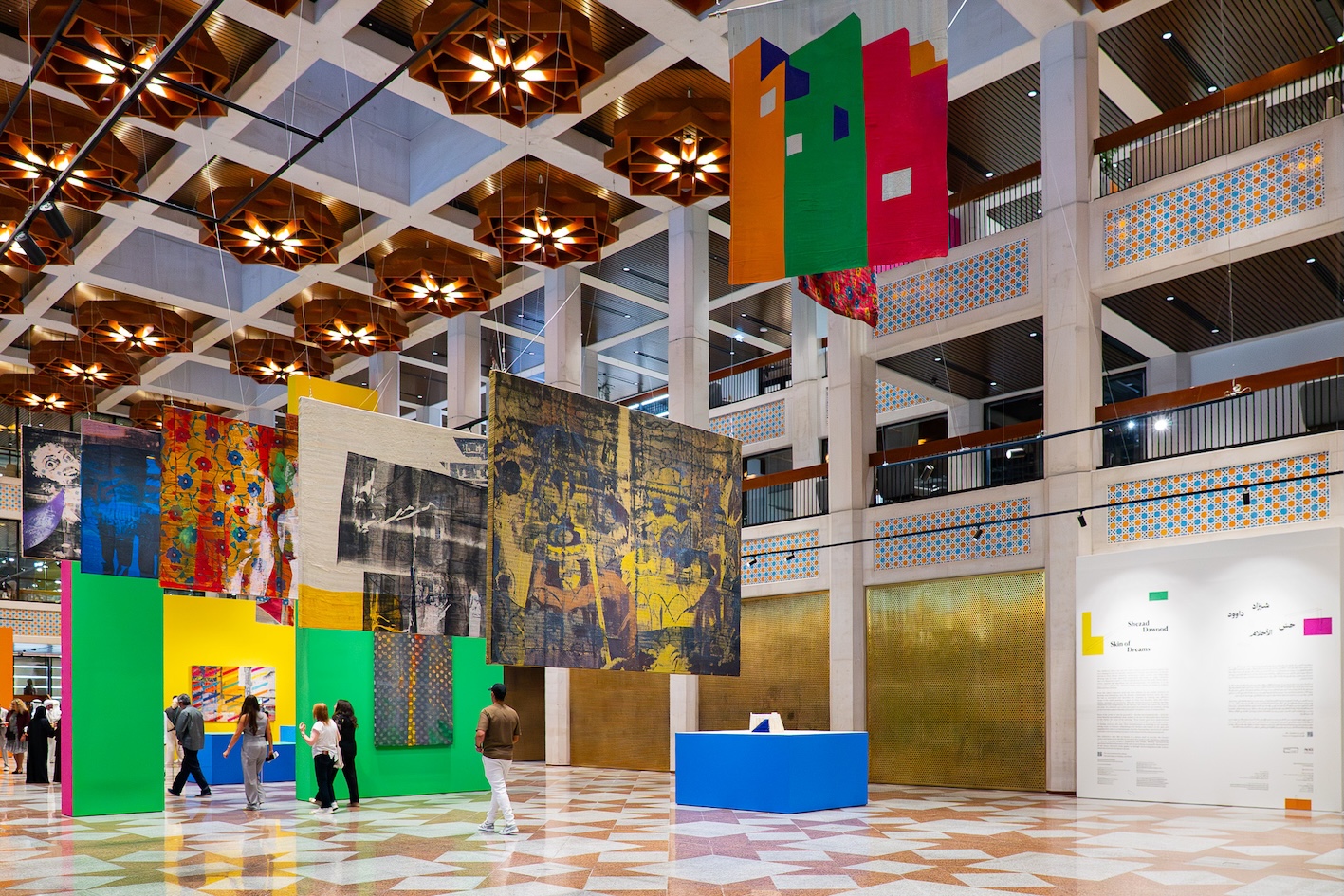
Conceived in dialogue with Cultural Foundation’s unique architecture, the exhibition responds to the building’s blend of Bauhaus clarity and Islamic geometric patterns, attending to light, proportion and integrated ornaments. Works are installed to open cross-views between spaces, playing with the rhythm of the galleries and distinctive elements such as large glass fronts, brass doors with mashrabiya motifs and mosaic tiles, set in deliberate contrast to the building’s raw concrete columns. Paintings, installations, video projections and sound establish a continuous exchange between Dawood’s vision and the architecture that hosts it. A modern-heritage landmark shaped by the founding vision of the late Sheikh Zayed bin Sultan Al Nahyan, Cultural Foundation remains a cornerstone of Abu Dhabi’s cultural life and continues to realise the country’s cultural ambitions.
Many of the works on display are deeply grounded, both literally and metaphorically, in South Asian histories and traditions. This is particularly evident in Dawood’s use of ralli textiles from Pakistan, which serve as the primary surface for many of his paintings. These found quilts, hand-stitched by artisans in the 1970s, retain visible traces of their household use and speak to the powerful themes of lineage, memory and care. Dawood’s reinterpretation of them as paintings exemplifies his collaborative approach to art, engaging with past traditions and adapting them to contemporary issues.
For the first time, the exhibition features an in-depth presentation of Dawood’s painting practice. It includes works he describes as ‘openers’ – paintings that have provided artistic breakthroughs throughout his career. Key works on display include Through Pierced Flesh and Skin of Dreams (2014), comprised of five suspended panels that visitors can walk around and between; The Wanderer (2015), developed during a residency at Sadler’s Wells Theatre exploring bodies in motion; and Island I (2011), an early painting incorporating photographic imagery that creates dynamic optical effects.
Architectural explorations feature prominently, with works from the Integrations series such as When Louis met Ahmed and Kenzo Rides Again (2023), which pay tribute to modernist buildings in the Global South. Other highlights include Anselm Chapel, Tokyo (2016), referencing Czech-American architect Antonin Raymond’s design, and Okpo Shipyard (2018), which explores industrial maritime infrastructure. The exhibition also features University of NonDualism (2020), a series of hangings and ceramics inspired by Bangladeshi architect Muzharul Islam, such as Solids and Voids (2020) and Situated Architecture (2020), and Biosphere (1980) (2023), a ceramic reconstruction honouring the former Intercontinental hotel in Sharjah.Earlier works such as Ibn Arabi’s Flower (2010), and Island I (2011)demonstrate the evolution of his practice.
Major recent installations include Night in the Garden of Love (2023) andNight in the Garden of Love (Digital Seedbanks) (2023), a multi-sensory work inspired by the 1988 novella by Dr Yusef Lateef. Seven algorithmically generated plants respond to an experimental soundtrack, accompanied by Xyloflor, a ceramic sculpture diffusing scents that blend natural and AI-developed fragrances. Corresponding painted works from the series are displayed as hangings throughout the space, including Tree of Many Colours (2023), Blue (2023), Osteospermum (2023), and Ambiguous Relationships (2023).
The exhibition also presents Encroachments (2019), alongside Clifton Beach (Digital terrazzo)[Black](2019), an elaborate virtual reality environment that takes participants on a journey through cultural spaces in Pakistan, exploring the country’s relationship with the USA since 1947.
The exhibition further showcases additional paintings that demonstrate the breadth of Dawood’s practice, from his early engagement with ralli textiles in Flow My Tears The Policeman Said II (2011), Cave Interior (2016)to recent pantings including For Minnette (Green) (2026) and For Minnette (Turquoise) (2026). Overall, these immersive works demonstrate Dawood’s mastery across painting, film, digital art and virtual reality.
At the heart of the exhibition is the highly anticipated premiere of Episodes 9 and 10 of Dawood’s seminal ten-part film series, Leviathan Cycle. Set several decades into the future, each episode offers a snapshot into how climate change and scientific developments may have reshaped life on Earth. Developed in collaboration with oceanographers, marine biologists and neurologists, the episodes draw on scientific research.
Episode 9, set in South Korea, examines the ethical ramifications of using genetic engineering and artificial intelligence (AI) to preserve biodiversity and maintain delicate ecosystems in balance. The film explores how marine science can have medical implications for humans, resulting in new and unexpected evolutionary pathways. Episode 10, filmed in Dawood’s home city of Karachi, takes place in what remains of South Asia after the world has ended more than once and is co-commissioned by Cultural Foundation Abu Dhabi. True to much of Dawood’s practice, these films intertwine two moments in time: a potential collective future and the urgent imperative to course-correct today.
Whether reinterpreting past unrealised architectural projects or speculating on future scientific developments, Dawood’s work is a guide through intersecting dream-like realms, where the physical and digital coincide. For audiences, it offers a glimpse into alternate realities, where everything can come together differently, even if momentarily.
Among Dawood’s earlier projects in the emirate was his participation in the inaugural edition of Manar Abu Dhabi, where he presented Coral Alchemy (Acropora Grove). This pioneering work explored coral growth and fragile ecosystems through the use of AI and thermochromatic paint.
Entry to the exhibition is free and open to all. For more information,visithttps://culturalfoundation.ae/en/exhibitions/shezad-dawood-skin-of-dreams