


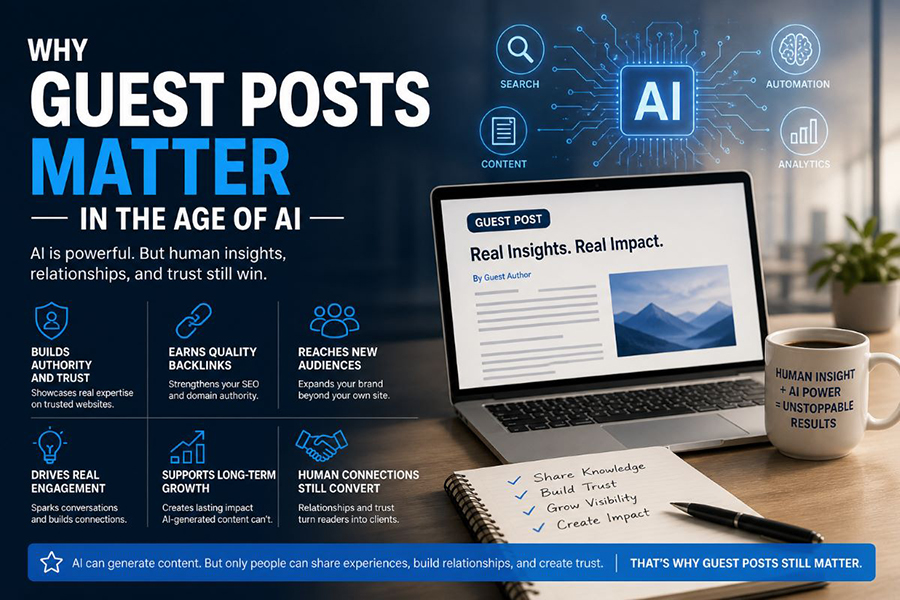
Ask any seasoned digital marketer whether guest posting is still relevant in 2026, and the answer will be unequivocal, not just relevant, but more essential than ever. As AI content generation floods the web with cheap, generic articles, the value of a real human voice published on a credible third-party platform has never been higher.
Guest posting, the practice of writing and publishing original content on another website in exchange for visibility, authority, and a contextual backlink has been a pillar of off-page SEO since the mid-2000s. What has changed is the stakes. According to Linkter.ai, guest posting today sits at the intersection of content marketing, link building, and digital PR, and its effectiveness now depends entirely on quality, relevance, and editorial integrity.
The SEO Case: Backlinks That Still Move Rankings
Despite every algorithm update over the past decade, backlinks from authoritative, niche-relevant sites remain one of Google’s most powerful ranking signals. Guest posting is the most reliable editorial method of earning them. StayDigitalMarketers (2025) confirms that guest posting improves domain authority, boosts organic search rankings, and drives long-term referral traffic, advantages that paid ads and social media simply cannot replicate.
The AI dimension sharpens this advantage considerably. As content farms use AI to mass-produce thin articles, Google’s algorithms are becoming more sophisticated at identifying and rewarding genuine expertise. The E-E-A-T framework — Experience, Expertise, Authoritativeness, and Trustworthiness, now governs how Google evaluates content quality. A guest post from a recognised expert, published on a site with real editorial standards, earns E-E-A-T signals that no AI-generated article can manufacture.
OutreachLabs reinforces this point: the most effective guest posts are those placed on topically relevant sites with engaged audiences, where the backlink is contextual, in-body, and editorially earned, not purchased or automated.
Brand Authority: Standing Out When Anyone Can Publish
When AI tools can produce a polished 800-word article in seconds, the scarcest thing a brand can offer is genuine thought leadership. This is exactly what strategic guest posting delivers. Publishing on verified, authoritative, niche-relevant sites buildstopical authority and real brand credibility that compounds over time.
Viral-Impact documents the measurable impact: businesses running consistent guest post campaigns report up to a 35% faster organic growth rate compared to those producing only owned content. One documented case study showed a domain rating climb from 21 to 51, accompanied by a 1,035% organic traffic increase, driven entirely by strategic guest posting over 12 months.
Brand authority built through guest posting has a compounding effect, each placement adds to a portfolio of credibility signals that search engines and human readers both respond to in a landscape flooded with AI noise, being vouched for by a reputable editor is a trust signal that stands apart.
Audience Growth: Reaching Readers AI Cannot Touch
Guest posting is fundamentally a distribution play. It places your ideas in front of an audience someone else has already built — readers who are pre-qualified by the host publication’s niche and pre-warmed by its editorial credibility. T-Ranks explains that this is why guest post referral traffic typically converts at higher rates than cold paid traffic: the reader arrives with context and trust already established.
StayDigitalMarketers presents data showing that guest posting continues to deliver strong ROI in 2026, with marketers citing it as one of the highest-return link-building strategies available, particularly for niche industries where a single well-placed article in the right trade publication can outperform months of social media activity.
Reddit’s r/GuestPosting community echoes this sentiment, with practitioners reporting that guest posting remains a core part of off-page SEO strategy precisely because it builds both link equity and real audience relationships simultaneously, something no automated AI content pipeline can replicate.
Trust in an AI-Saturated World
Perhaps the most important argument for guest posting in 2026 is the one hardest to quantify: trust. When AI can write a convincing article on any topic without human expertise or accountability, a bylined guest post, where a named professional stakes their reputation on their claims carries extraordinary weight.
Reddit’s r/SEO_LLM community documents this tension directly: as AI-generated off-page content proliferates, SEO professionals are observing that editorially placed, human-authored guest posts are increasingly outperforming AI-assisted content in sustained ranking performance. The reason is simple — editorial gatekeeping is itself a trust signal. When a respected publication accepts your article, it is endorsing not just your content but your credibility.
How to Do It Right in 2026
For Writers
- Lead with a unique angle grounded in personal experience or original data — not information AI can replicate from public sources.
- Research the host publication’s guidelines, tone, and audience before pitching. Editors instantly reject generic, mass-produced pitches.
- Write for the reader first, the backlink second. Linkter.ai is clear: the distance between a legitimate editorial guest post and a spam flag has never been wider.
- Build a genuine relationship with the editor — one quality placement often opens the door to a recurring column.
For Publishers
- Verify contributor credentials independently. AI can generate plausible-sounding bios and bylines in seconds.
- Require original data, case studies, or first-hand experience that proves a human was meaningfully involved in the content.
- Maintain a clear editorial brief — audience, tone, word count, prohibited topics. This filters low-effort AI submissions naturally.
- Use AI-detection tools as one signal among several, not as your sole quality gate.
A Human Strategy for a Machine Age
Guest posting has survived algorithmic updates, the rise of social media, and now the generative AI revolution — because it is built on something enduringly valuable: a credible human voice, placed deliberately, in front of a relevant audience, with an editor’s endorsement backing every word.
As AI content becomes cheaper and more ubiquitous, the scarcity value of authentic, accountable, expertly authored content will only increase. Brands and writers who invest in quality guest posting using the principles and sources cited throughout this article are not swimming against the AI tide. They are positioning themselves on the only shore that holds firm: genuine human expertise, verified and trusted.
Guest posting is not dying. In the age of AI, it is becoming the most powerful trust signal the open web has left.